Practice Management · 2 min read
How to Digitize Your Nutrition Practice Without Losing the Human Touch
If you are still relying on paper notes, spreadsheets, PDFs, and scattered emails, you are not behind. You are normal.
Most nutrition practices start with the tools already on hand. The problem is that those tools become harder to manage as the client list grows.
Digitizing your nutrition practice is not about becoming less personal. It is about giving your personal care a better system.
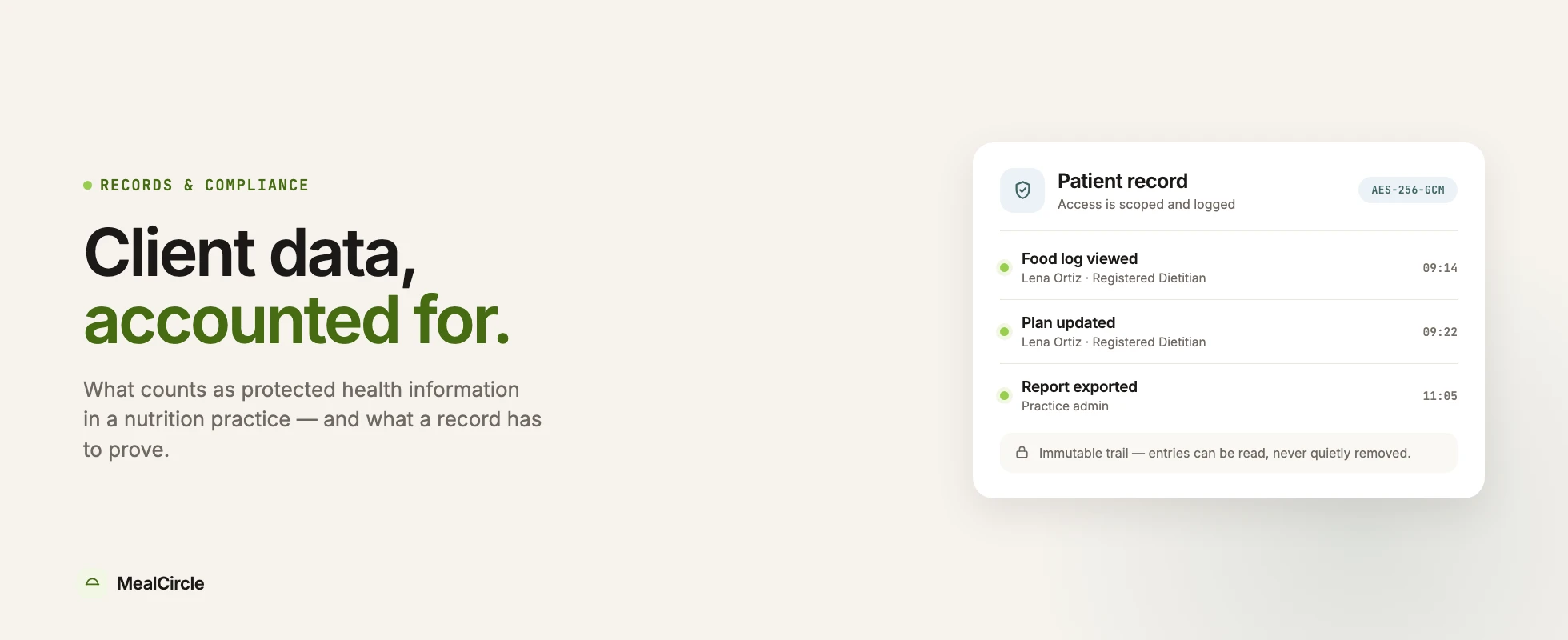
If you handle sensitive client information, security needs to be part of the workflow from the beginning.
Instead of sending every plan and food journal through generic tools, use HIPAA-compliant nutrition software designed for health and wellness workflows. For a deeper breakdown, read what makes meal planning software HIPAA compliant.
How much time do you spend formatting plans, rebuilding grocery lists, finding the latest client note, or asking someone to resend a food log?
Digitizing allows you to:
If you are also considering generative tools, use our AI for dietitians evaluation guide to separate low-risk drafting from clinical decisions that require stronger evidence, privacy controls, and human review.
Clients are more likely to stay engaged when the next step is easy to find.
A dietitian client portal can keep meal plans, messages, food journals, and follow-up tasks in one place. Pair that with a retention board that flags drifting clients, and you support better nutrition client retention because clients are not relying on memory or old email threads.
A digital practice also makes your own work more flexible. You can review a client before a session, update a plan, or check recent notes without being tied to one folder on one device.
Digitizing is not about replacing the human connection. It is about removing the administrative friction around it.
Start with the workflow that hurts most: meal plans, food journals, messaging, or follow-up. Review the benefits of nutrition practice management software, then choose nutrition software for dietitians that helps those pieces work together.
Start with the workflow causing the most friction, then choose secure tools that keep client context connected. A specialized practice platform can reduce fragmentation, but the right setup depends on the practice’s services, privacy obligations, and existing systems.
It can be safe when the exact service, plan, settings, access controls, contracts, and practice procedures meet your privacy obligations. Consumer email or document tools should not be assumed suitable for protected health information without confirming their safeguards and, where required, a Business Associate Agreement.
Food logs and meal photos can be PHI in a dietitian's care workflow. Learn when HIPAA applies, when it may not, and what to check before choosing an app.
Read →Foodzilla vs NutriAdmin in 2026: compare meal planning, client portals, food logging, practice tools, HIPAA options, and current pricing.
Read →A transparent five-level framework for dietitians to prioritize follow-ups using urgency, care-plan timing, observable changes, barriers, and practitioner review.
Read →See how MealCircle connects plans, patient activity, and follow-up without adding another disconnected tool.