Food Journals · 5 min read
The 7 Best Food Journal Apps for Dietitians & Their Clients (2026)
The best food journal app is not the one with the biggest food database. It’s the one your client will still be using in week six — and that tells you something useful before the next session.
That lens changes the rankings. Here are the seven worth knowing in 2026, based on publicly available information as of July 2026.
| App | Type | Practitioner visibility | Best for |
|---|---|---|---|
| MealCircle patient app | Practitioner-connected | Full — logs, adherence, gaps | Clients under active care |
| Cronometer (+ Pro) | Consumer + pro dashboard | Full with Pro ($39.99/mo) | Nutrient-data depth |
| MyFitnessPal | Consumer | None built-in | Self-directed clients |
| Ate | Consumer, photo-based | Coach view available | Mindful/anti-diet approaches |
| Nutrium app | Practitioner-connected | Full (with Nutrium) | Nutrium practices |
| See How You Eat | Consumer, photo-based | Screenshots/export | Visual meal balance |
| Paper / template | Analog | Whatever clients bring | Low-tech clients |
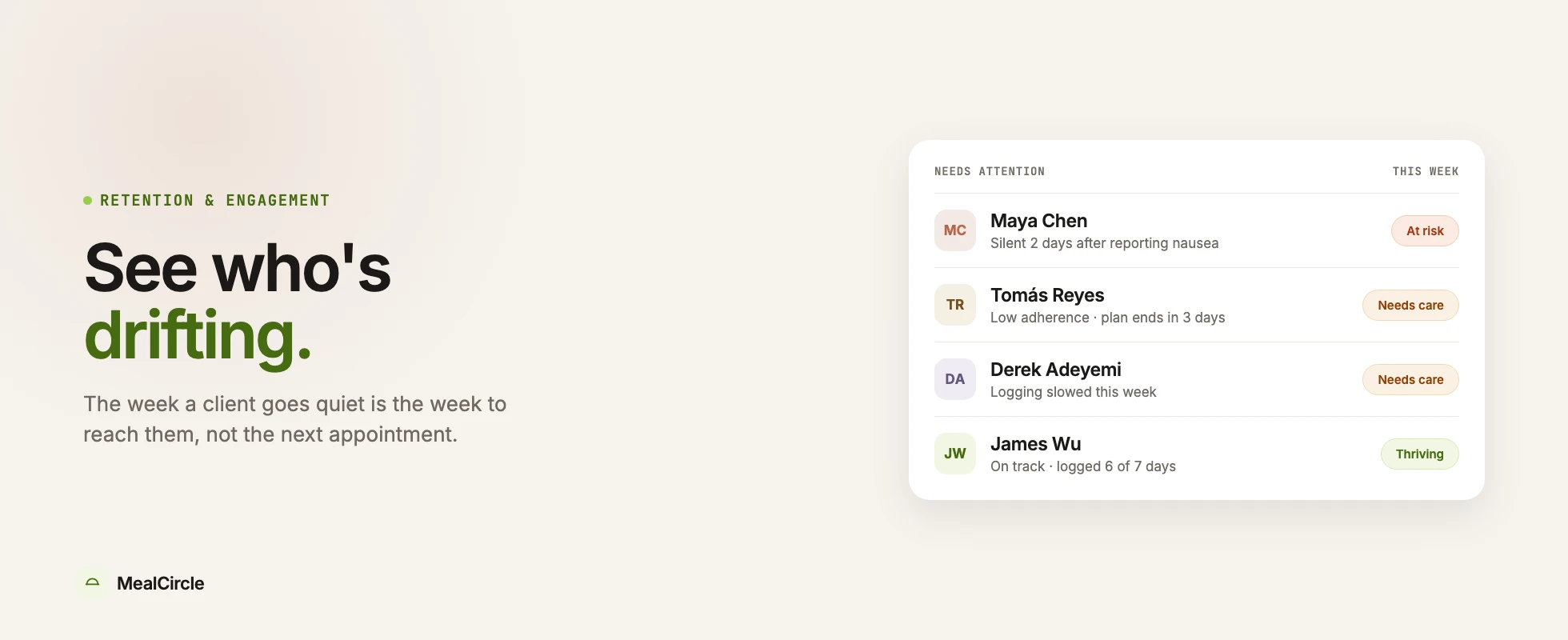
Full disclosure: our product. The MealCircle patient app treats the food journal as part of care, not a standalone tracker: clients log against their assigned meal plan, and the dietitian sees adherence, gaps, and drift signals on the retention board — so a quiet week of missed logs becomes a follow-up prompt, not a surprise at the next appointment.
Cronometer logs against verified nutrient data (up to 84 micronutrients), which makes it the reference choice when precision matters — clinical cases, athletes, micronutrient work. Pair it with Cronometer Pro ($39.99/mo, 10 client seats) and you get a practitioner dashboard over your clients’ logs.
Still the most-installed food tracker on earth, with a giant food database and barcode scanning. Free tier with ads; premium subscription for macros-by-meal and no ads.
Ate replaces numbers with photos and reflection prompts (“how did this meal make you feel?”). For clients where calorie counting is counterproductive — intuitive eating, ED-recovery-adjacent work — it’s the humane option, and coaches can get a review view.
Nutrium’s included client app does solid plan-connected logging with messaging. If your practice already runs on Nutrium (~$15–25/mo), it’s the obvious journal; there’s no reason to use it otherwise.
A photo-grid journal from Finland: clients photograph meals into a day-grid, making balance and gaps visually obvious without any counting. Good for teaching plate composition; export/screenshots for the practitioner.
Some clients log best with a pen. A structured food journal template (we made a free one) with meal, time, hunger, and symptom columns beats an abandoned app every time. The failure mode is legibility and review friction — which is usually what eventually drives the upgrade to a connected app.
For the bigger picture — records, plans, messaging, and journals in one system — see our guide to the best apps for nutritionists to manage clients.
For dietitians who want logs connected to care, MealCircle’s patient app links food journals to the meal plan and flags missed logging. For nutrient-data depth, Cronometer (with Cronometer Pro for practitioner review) is the strongest. MyFitnessPal remains the easiest app clients already know, though it shares little with the practitioner.
Consumer apps like MyFitnessPal and Cronometer work well for motivated self-trackers, but the dietitian usually sees nothing unless the client exports or screenshots logs. Practitioner-connected journals feed logs, adherence, and gaps directly into the care workflow — which is what changes follow-up.
Meals and timing at minimum; ideally also hunger, fullness, symptoms, mood, photos, and notes. For weight-loss care, adherence to the plan matters more than gram-perfect logging. For GI work (IBS, FODMAP), symptom fields are essential.
For many clients, yes — photo logging takes seconds, removes the calorie-counting trigger, and shows the dietitian what was actually eaten. Apps like Ate built their whole model on it. The trade-off is less structured nutrient data.
A plain-English guide to nutrition patient portals, client portals, meal plans, food logs, messaging, forms, and follow-up in dietitian practices.
Read →Food logs and meal photos can be PHI in a dietitian's care workflow. Learn when HIPAA applies, when it may not, and what to check before choosing an app.
Read →Foodzilla vs NutriAdmin in 2026: compare meal planning, client portals, food logging, practice tools, HIPAA options, and current pricing.
Read →See where MealCircle fits, where it does not, and whether retention-focused practice management matches your care model.