Software · 8 min read
The 8 Best Apps for Nutritionists to Manage Clients in 2026
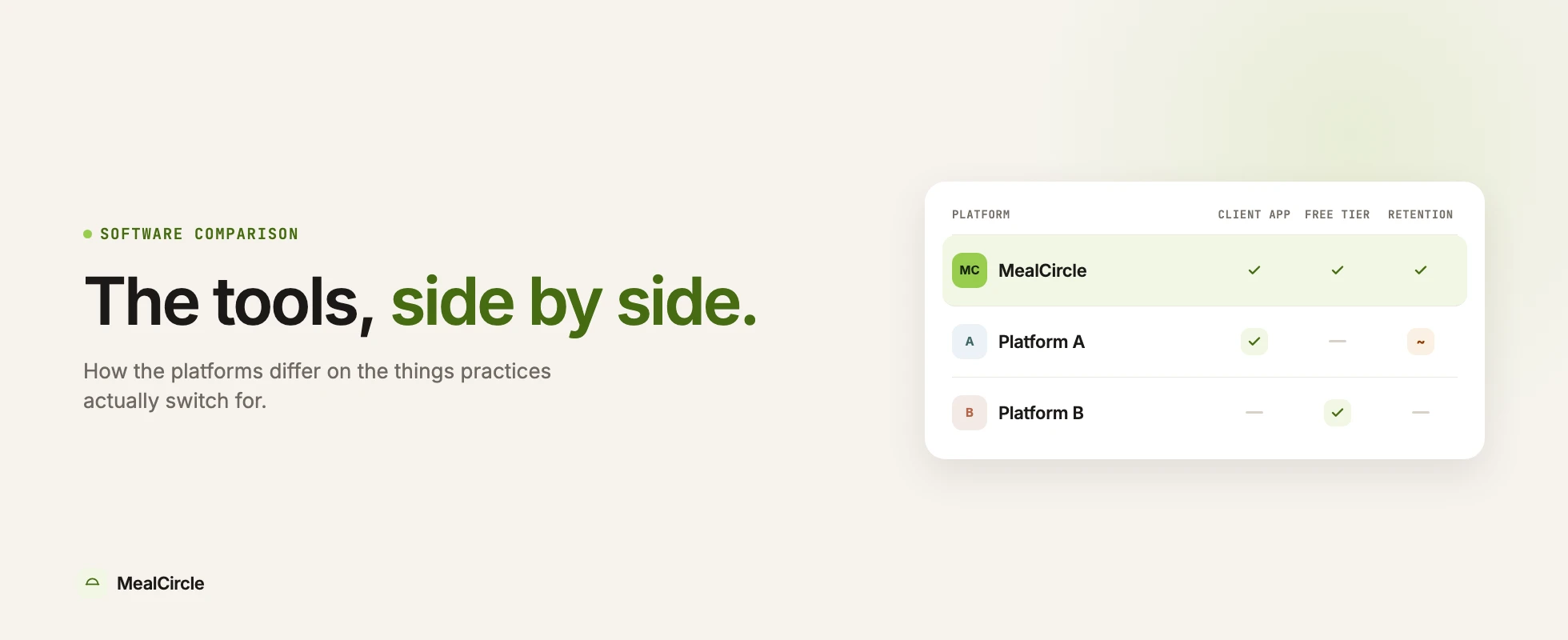
The apps a nutritionist chooses decide two things: how much admin the practitioner carries, and whether the client stays engaged between sessions.
Most “best apps” lists only score the first. But client management lives or dies on the second — a client who stops opening the app is a client who’s already halfway out the door.
The short version: MealCircle if client engagement and retention drive your revenue, Healthie if you bill insurance, Practice Better if you want the broadest all-in-one, Foodzilla if you want a cheap white-label app with your own branding on it.
Everything below is based on publicly available information as of July 2026 — confirm details on vendor sites.
We checked official pricing, client-app, product, and security documentation on July 15, 2026. We scored the client experience separately from the practitioner dashboard, then checked whether food logging, messaging, and follow-up stay connected. MealCircle is our product, and we have included situations where an EHR, a broader wellness platform, or a dedicated nutrition-analysis app is the better fit.
| App | Client mobile app | Food logging | HIPAA / BAA | Starting price |
|---|---|---|---|---|
| MealCircle | Free, iOS + Android | Yes, plan-aware | Yes, BAA on paid plans | Free to start |
| Healthie | Yes | Yes | Yes | $19.99/mo (10 clients) |
| Practice Better | Yes | Yes (journaling) | Yes | $35/mo |
| Nutrium | Yes (branded) | Yes | BAA included in terms | ~$15/mo (annual) |
| Foodzilla | Yes, white-label option | Yes | Dedicated HIPAA plan disables client features | Confirm current plan |
| Cronometer Pro | Yes (consumer app) | Yes, deepest data | Yes | $39.99/mo (10 clients) |
| NutriAdmin | No — web portal | Portal-based | HIPAA claimed; confirm BAA | $34.99/mo |
| That Clean Life | No — web/PDF plans | No | No public BAA found | $30/mo |
MealCircle connects the two halves of client management that usually live in different tools: your side (client records, meal plans, notes, messaging) and the client’s side (a free mobile app for logging meals, quick check-ins, and messages).
What makes it different is what happens between sessions. Every client’s logging activity, check-ins, and plan adherence feed a retention board that ranks your caseload into plain health states — so the client who stopped logging on Tuesday shows up on your list Wednesday, not at a no-show three weeks later.
Healthie pairs a capable client app (booking, telehealth, food journaling, messaging) with the deepest back office in the space: EHR, superbills, insurance claims, faxing.
Practice Better’s client app covers messaging, journaling, reminders, programs, and protocols, backed by scheduling and telehealth on the practitioner side. Its 2023 acquisition of That Clean Life is steadily improving its meal-plan content.
Nutrium includes a branded client mobile app — meal plans, logging, messaging — at some of the lowest prices in the market, on top of a structured clinical consultation workflow.
Foodzilla’s standout is a branded client experience alongside fast meal-plan generation. Its compliance model now needs careful plan selection.
Your clients log in the consumer Cronometer app — polished, familiar, verified data on 84 micronutrients — and you watch everything from a professional dashboard.
NutriAdmin focuses heavily on the practitioner side: CRM, questionnaires, scheduling, payments, and quick plan generation. But there is no native client app — clients use a web portal.
That Clean Life (owned by Practice Better) specializes in photographed recipes, reusable templates, and polished meal-plan documents. But as a client management tool it opts out: no clinical client record or native client app — plans are shared through secure links and PDFs.
Plenty of nutritionists start with a stack of free tools: plans in Google Docs, scheduling via a calendar link, payments by invoice, messages on WhatsApp, logs in whatever tracker the client already had.
It works — until the caseload grows. Then nothing talks to anything else, client context scatters, and follow-up starts depending on memory. That’s the moment to consolidate onto nutrition practice management software, or at minimum a client portal that keeps plans, logs, and messages in one place. (If WhatsApp is your client channel today, see why practices outgrow it.)
The right app depends on the practice model. MealCircle is designed for retention-focused nutrition workflows, Healthie for insurance-based practices, Practice Better for broad wellness services, and Foodzilla for meal planning and a branded client experience. US clinical practices should confirm whether the exact Foodzilla plan they choose supports both their client workflow and HIPAA requirements.
On many platforms the client app is included in the practitioner’s subscription. MealCircle’s patient app is free for clients. Check client caps and seat charges on the exact plan: Cronometer Pro, for example, includes 10 client spaces and charges for additional active spaces.
Yes on MealCircle, Healthie, Practice Better, Nutrium, Cronometer Pro, and Foodzilla — each includes client-side food logging. NutriAdmin and That Clean Life deliver plans through a web portal or PDF instead, with no native client app.
A connected platform usually wins as a practice grows: when the plan, the food log, and the messages live in one system, follow-up has context. App stacks built from separate scheduling, planning, and messaging tools leak client context between the gaps.
Foodzilla vs NutriAdmin in 2026: compare meal planning, client portals, food logging, practice tools, HIPAA options, and current pricing.
Read →Compare leading EHR options for dietitians in 2026, including Healthie, Kalix, and Practice Better, plus when a full EHR may be unnecessary.
Read →Compare 7 Healthie alternatives for dietitians in 2026 by pricing, client apps, HIPAA support, core workflows, and the practices each platform fits.
Read →See where MealCircle fits, where it does not, and whether retention-focused practice management matches your care model.