Software · 6 min read
Best EHR for Dietitians & Nutritionists in 2026 (And When You Don't Need One)
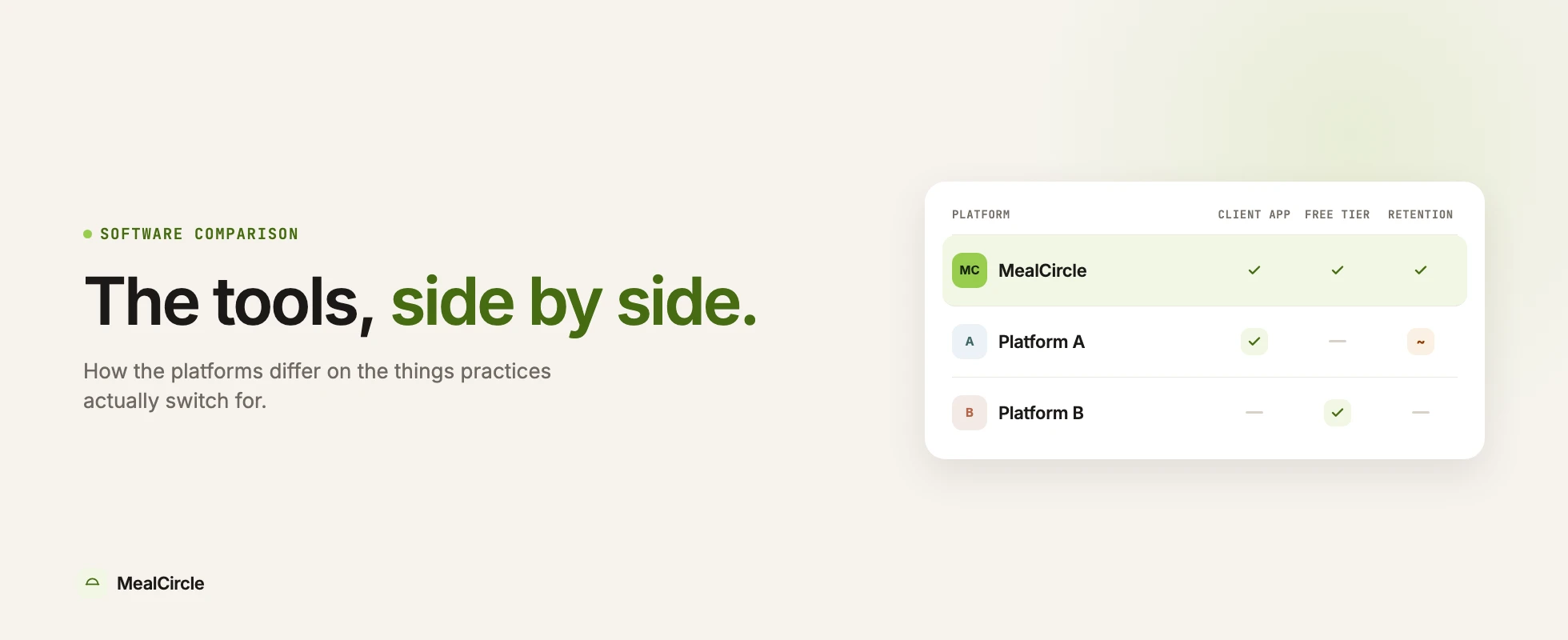
“Best EHR for dietitians” is really two questions wearing one search query: which EHR should I buy? — and, more often than people expect — do I actually need an EHR at all?
We’ll answer both honestly. And since MealCircle is not an EHR, we have no horse in the first race — which makes this a rare vendor post that can just tell you the truth.
The short version: if you bill insurance, buy Healthie. If you need compliant RD charting on a budget, buy Kalix. If you want broad practice management with decent documentation, Practice Better. If you’re cash-pay and were told you “need an EHR” — read the last section before spending anything.
Based on publicly available information as of July 2026.
We checked official vendor pricing, charting, billing, security, and BAA documentation on July 15, 2026. The comparison separates full EHR functions—structured clinical records, claims, interoperability, and prescribing—from practice-management functions such as scheduling, meal planning, messaging, and engagement. We did not test every paid workflow, so buyers should validate claims and migration requirements with each vendor.
The label gets used loosely. A real EHR for nutrition practice means:
Scheduling, meal planning, and client apps are practice-management features. Plenty of tools have those without being EHRs — and vice versa.
Among the nutrition-focused platforms reviewed here, Healthie covers the broadest portion of the EHR checklist: charting, CMS-1500 claims, superbills, optional e-prescribing, faxing, lab integrations, telehealth, and API options.
Kalix is an EMR built by dietitians: ADIME-style documentation, assessment fields that match how RDs actually chart, HIPAA + PIPEDA compliance, unlimited clients.
Practice Better isn’t a full EHR — no e-prescriptions, lighter billing — but its charting, forms, and protocols cover what many documentation-conscious practices actually use, wrapped in a far friendlier product.
Here’s the part most “best EHR” listicles won’t say: a cash-pay nutrition practice usually doesn’t need an EHR. No claims to file, no referring hospital demanding chart exports — what it needs is:
That’s the layer MealCircle is built for: the Patient 360 record, plan builder, free patient app, and retention board — free to start, BAA on paid plans, no claims machinery you’d be paying to ignore. It’s deliberately not an EHR; practices that need one usually run Healthie or Kalix for documentation-heavy cases and keep the engagement layer separate.
Decision rule of thumb: start with the workflow you are legally and operationally required to support. If claims, prescribing, or formal interoperability are essential, evaluate a full EHR. If the work centers on plans, logging, and follow-up, compare lighter nutrition practice management software before paying for EHR functions you may not use.
Among the nutrition-focused platforms reviewed here, Healthie has the broadest EHR and insurance workflow, starting at $19.99/month for 10 active clients. Kalix starts at $27/month with RD-oriented charting. Practice Better is a broader practice platform with documentation features. Cash-pay practices should first determine whether they need full EHR functions.
Only if they bill insurance, work in referral chains that require formal clinical documentation, or operate inside medical organizations. A cash-pay private practice usually needs charting-lite client records, meal planning, and follow-up tools — not claims processing — and pays a real cost in complexity for EHR features it never uses.
An EHR centers on clinical documentation and billing: charting, claims, superbills, e-prescriptions, faxing. Practice management software centers on running the practice: scheduling, client records, meal plans, client apps, messaging, and follow-up. Healthie is an EHR that added practice tools; MealCircle and Practice Better are practice platforms that added documentation.
Free plans rarely include the complete charting, claims, interoperability, and compliance support expected from a full EHR. If you only need client records, plans, logging, and follow-up rather than insurance claims, a lighter practice-management platform may fit better.
Foodzilla vs NutriAdmin in 2026: compare meal planning, client portals, food logging, practice tools, HIPAA options, and current pricing.
Read →Compare 7 Healthie alternatives for dietitians in 2026 by pricing, client apps, HIPAA support, core workflows, and the practices each platform fits.
Read →A practical comparison framework for Healthie, Practice Better, Nutrium, and nutrition practice software alternatives.
Read →See where MealCircle fits, where it does not, and whether retention-focused practice management matches your care model.