Pricing · 3 min read
How Much Should Dietitians Charge for Meal Plans?
Meal plan pricing gets awkward because it is not really about the meal plan.
It is about the thinking behind it, the personalization, the revisions, the follow-up, and the support that helps a client actually use it.
If you only charge for the document, you can end up underpricing the work.
Before choosing a price, define the deliverable.
Are you selling:
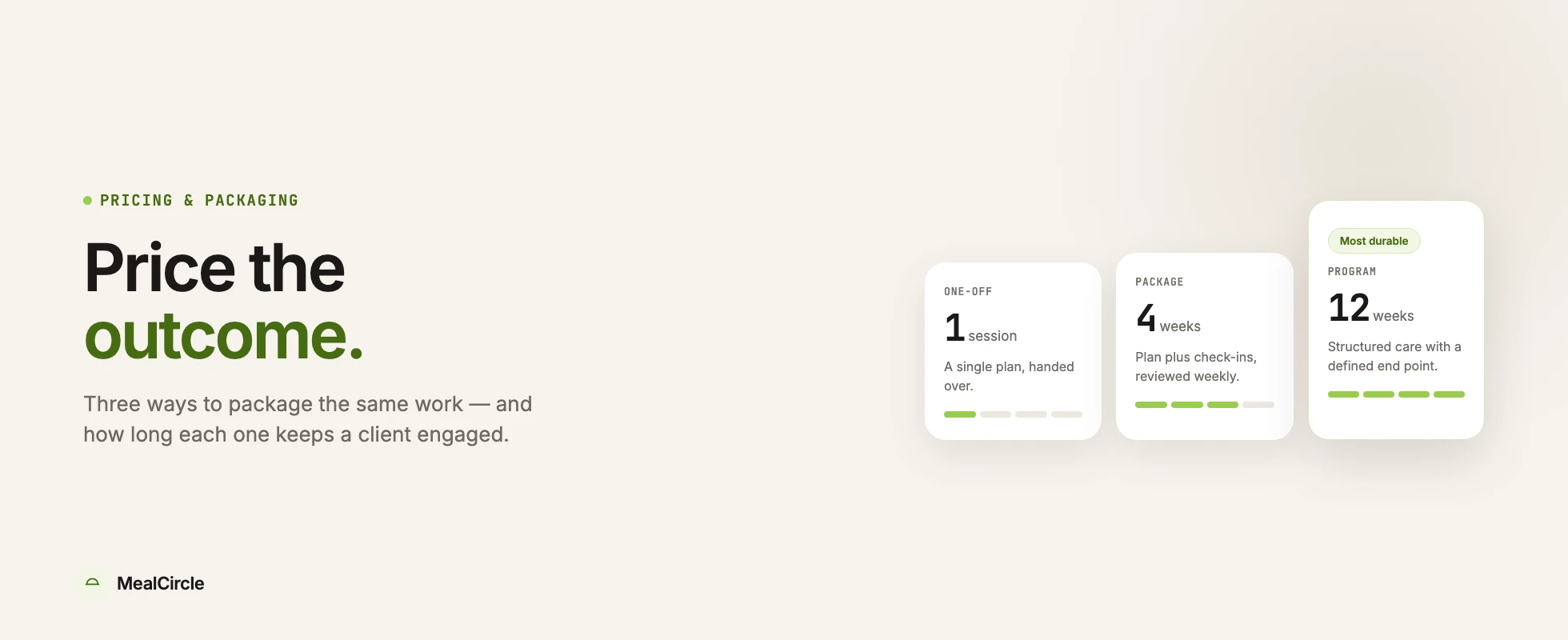
Each offer has a different value and a different workload.
This is a simple, standalone deliverable.
It can work well for clients who want a starting point, but it has a weakness: once the plan is sent, the relationship can go quiet.
If you sell one-time plans, define what is included:
This is stronger because it gives the plan context.
The consultation helps you understand the client’s goals, food preferences, schedule, and barriers. The plan then becomes a personalized tool instead of a generic file.
This model supports recurring care.
Clients pay for ongoing adjustments, check-ins, and updated plans. It can be healthier for your business because revenue becomes more predictable and clients stay engaged longer. It can also be better for clients because nutrition plans often need refinement after real life gets involved.
This is usually the strongest model for private practices.
The meal plan becomes one part of a larger outcome:
Clients are paying for guidance, not just pages.
Consider:
Avoid copying another dietitian’s price without understanding their offer, audience, and workload.
Meal plan work often includes:
If your price only accounts for the visible plan, your margins may be thinner than they look.
Software can make meal plans more profitable by reducing repeat admin:
That does not mean you should charge less. It means you can deliver a better experience with less manual drag.
For a deeper workflow view, see meal planning software for dietitians.
Do not price meal plans like documents if clients experience them as guidance.
Charge for the outcome, the personalization, and the support around the plan. A clear offer is easier to sell, easier to deliver, and much easier to scale as you grow and manage your practice.
Pricing varies by market, experience, personalization, and support. Many practices charge differently for a simple template, a custom plan, and a plan bundled with follow-up sessions.
Meal plans usually work better inside packages because clients often need follow-up, adjustments, and accountability after the plan is delivered.
Software can reduce time spent formatting, duplicating plans, building grocery lists, sending files, and tracking follow-up, which can improve margins without lowering care quality.
Stop undercharging. Learn how to structure your pricing packages to grow your income and attract committed clients.
Read →A practical guide to meal plan pricing for dietitians, including one-time plans, monthly updates, nutrition coaching packages, and software-driven margins.
Read →Foodzilla vs NutriAdmin in 2026: compare meal planning, client portals, food logging, practice tools, HIPAA options, and current pricing.
Read →See where MealCircle fits, where it does not, and whether retention-focused practice management matches your care model.