Client Retention · 4 min read
Why Nutrition Clients Stop Logging Meals
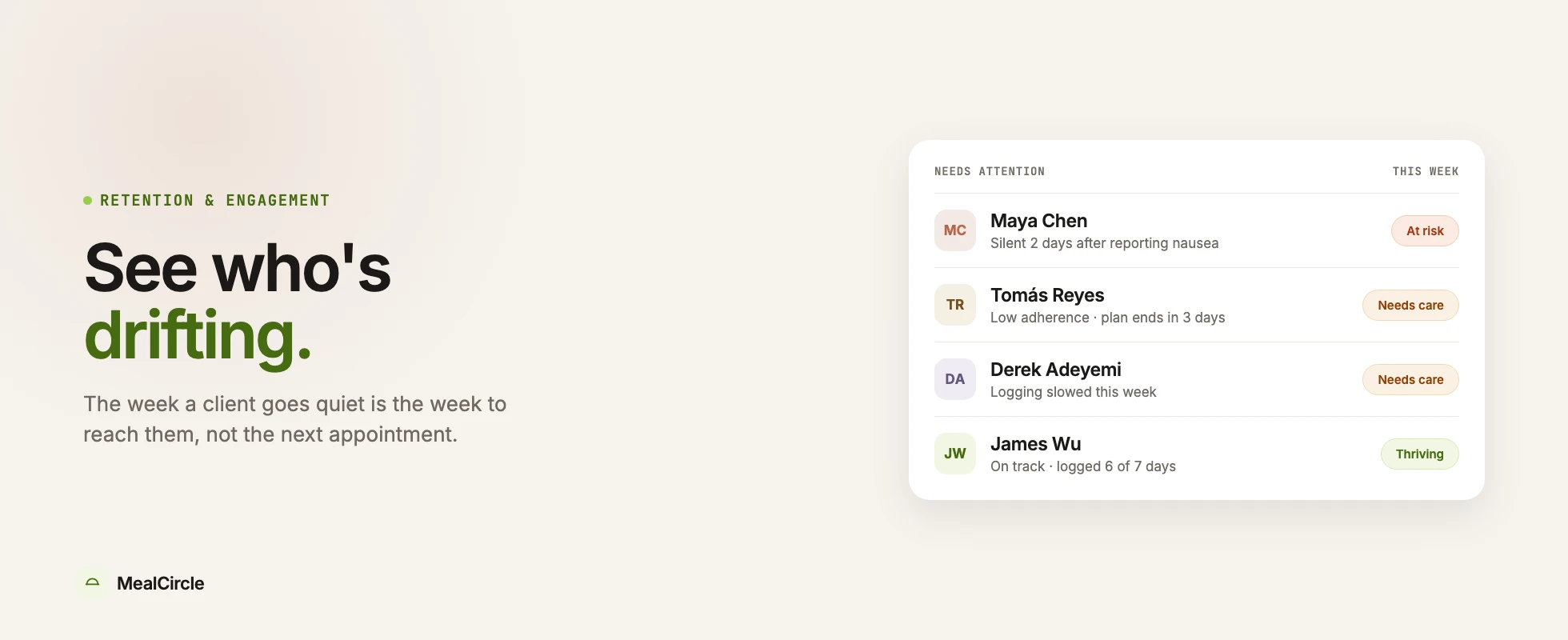
When a client stops logging meals, it is easy to assume they lost motivation.
Sometimes that is true. More often, the log stopped because the system became too heavy, too vague, or too emotionally loaded.
Meal logging is not just a data problem. It is a behavior problem. And behavior needs friction to be low enough that the client can keep going on an ordinary day.
Detailed tracking can become exhausting.
If clients have to search every ingredient, estimate every portion, and explain every snack, logging starts to feel like a second job. That may work for a few days. It rarely works forever.
Try lowering the effort:
A useful food journal template should match the care goal, not collect everything possible.
Clients are more likely to log when they understand how the information will be used.
Instead of saying, “Track your meals this week,” try:
“Log breakfast and lunch for three weekdays so we can see where your energy dips are coming from.”
That small explanation changes the task from surveillance into problem-solving.
Some clients stop logging because they do not want to show the hard days.
This is especially common when food has been tied to guilt, restriction, or past dieting experiences. If the client thinks the journal is a grade, they may only log the “good” days or stop entirely.
Set the frame early:
The tone of your follow-up matters as much as the tool.
If a client logs for a week and nobody mentions it, they learn that logging does not matter.
You do not need to review every line. But you do need to close the loop:
This is where a connected dietitian client portal can help. Food logs are more valuable when they are visible before the follow-up, not buried in screenshots or attachments.
Many food journal apps for dietitians are designed around calories, streaks, and database entries. That can be useful for some clients, but it is not the whole picture.
Dietitians often need context:
If the tool only rewards precision, clients who need support may feel like they are failing.
A missed log is not just an empty cell. It is a signal, and a client retention dashboard can surface it before a quiet client drifts away.
Ask:
That conversation often gives you more useful information than the missing entries would have.
Clients do not need to log perfectly for food journals to be useful.
They need a simple method, a clear reason, and a follow-up process that turns logs into support. When logging feels connected to care, clients are more likely to keep going.
Clients often stop logging meals because the process feels too time-consuming, too judgmental, unclear in value, or disconnected from follow-up.
Dietitians can improve logging adherence by simplifying what clients track, explaining why it matters, reviewing logs consistently, and using missed logs as a follow-up signal instead of a failure.
Not always. Some clients benefit from short logging windows, photo logs, symptom-focused journals, or habit check-ins instead of daily detailed tracking.
A practical 10-minute food-log review checklist for dietitians: verify the record, scan safety, find patterns, identify barriers, and prepare the next question.
Read →A practical food journal template guide for dietitians, including what clients should track and how to use logs without creating shame or busywork.
Read →Food logs and meal photos can be PHI in a dietitian's care workflow. Learn when HIPAA applies, when it may not, and what to check before choosing an app.
Read →See how MealCircle connects plans, patient activity, and follow-up without adding another disconnected tool.